Domaine Dexaïe, Sierra de Gredos
Emerging from the towering, remote Sierra de Gredos comes a project of passion for a duo well-equipped for such a mission. Carmen and Emmanuel acquired a small assortment of Garnacha vines in the Alto Alberche section, and acquired dozens of small plots of vines nearby to create something of a true blend of vineyards. The vision is to create true wines of place - revitalizing ancient vineyards while breathing in new life to the region without losing the deep sense of culture within the region.
VITICULTURE & VINIFICATION
The total of the 14 hectares under vine are exclusively planted to Garnacha, save for a couple Tempranillo vines - “For the birds,” Emmanuel says. While surrounded by rock faces, the vineyards themselves are mostly on a plateau with a subtle slope. Sand and silt sit on top of granitic subsoils, the silt a subtle reminder of the Paleozoic era, when the entire region was covered by ocean until the Central System, a range of mountains of which the Sierra de Gredos belongs, was created some two million years ago.
With the aforementioned harsh winds that permeate into the Domaine’s vineyards through a “window” in the mountain range, Emmanuel was quick to point out the nature of the training: Gobelet. As it is a natural progression of the Alberello training method seen in other windy sites (Mount Etna, for one), Gobelet was largely used in the ancient vines since it provided some shelter for the clusters. WIth the steadiness of the winds throughout the growing season, there is little disease pressure, even with the annual 700-1200 millimeters of rainfall. “Only with a very late rainfall, would we see any risk of botrytis,” says Emmanuel, “And in 2024 & 2025 we had no rain whatsoever during harvest.”
Gobelet necessitates manual farming, and in the old vineyards no tractors can be used due to spacing and the large rocks throughout. Emmanuel and Carmen are dedicated to retaining their fully manual farming, while with the newer plantings allowing space for a tractor, though only to assist with plowing. “We don’t ever hope to have large yields,” Carmen assuredly points out, “And we watch the vines to make sure the best bunches survive; less, grapes, yes, but bigger grapes. We want juicy, tight bunches.
After the harvest, the plots are vinified separately, preserving the stems for much of the clusters and covering the top with de-stemmed grapes. The grapes are then foot-trodden, and allowed to ferment & macerate with the skins for 1-2 months. After a quick pressing, the juice is aged in neutral oak barrels, before being blended and aged in larger oak vessels for up to two years.
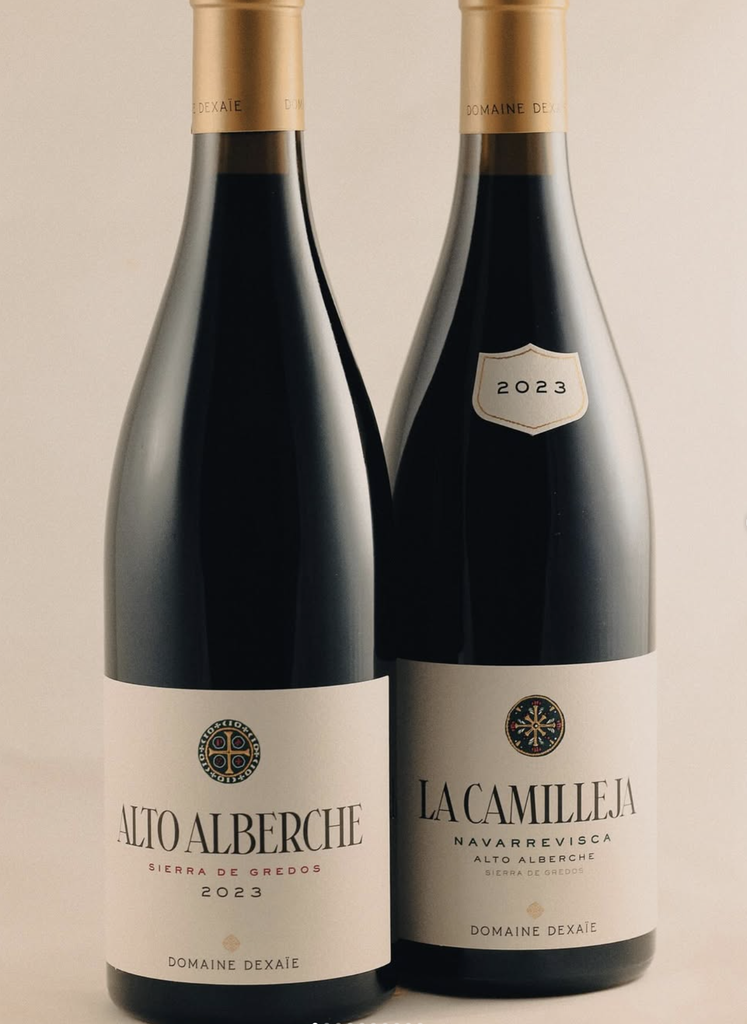
The duo seem intent on further sectioning off parcels as their newer plantings come on line, and as they attain further grasp on the individuality of their vineyards in coming vintages. “ We need to wait to produce,” they say. “Alto Alberche” is a “village” style wine, sourced from 3-4 different growers in addition to their own vines. “La Camilleja” translates to “Small Road”, and is sourced entirely from their own vineyards at 1100-1200 feet altitude.
Emerging from the towering, remote Sierra de Gredos comes a project of passion for a duo well-equipped for such a mission. Carmen and Emmanuel acquired a small assortment of Garnacha vines in the Alto Alberche section, and acquired dozens of small plots of vines nearby to create something of a true blend of vineyards. The vision is to create true wines of place - revitalizing ancient vineyards while breathing in new life to the region without losing the deep sense of culture within the region.
VITICULTURE & VINIFICATION
The total of the 14 hectares under vine are exclusively planted to Garnacha, save for a couple Tempranillo vines - “For the birds,” Emmanuel says. While surrounded by rock faces, the vineyards themselves are mostly on a plateau with a subtle slope. Sand and silt sit on top of granitic subsoils, the silt a subtle reminder of the Paleozoic era, when the entire region was covered by ocean until the Central System, a range of mountains of which the Sierra de Gredos belongs, was created some two million years ago.
With the aforementioned harsh winds that permeate into the Domaine’s vineyards through a “window” in the mountain range, Emmanuel was quick to point out the nature of the training: Gobelet. As it is a natural progression of the Alberello training method seen in other windy sites (Mount Etna, for one), Gobelet was largely used in the ancient vines since it provided some shelter for the clusters. WIth the steadiness of the winds throughout the growing season, there is little disease pressure, even with the annual 700-1200 millimeters of rainfall. “Only with a very late rainfall, would we see any risk of botrytis,” says Emmanuel, “And in 2024 & 2025 we had no rain whatsoever during harvest.”
Gobelet necessitates manual farming, and in the old vineyards no tractors can be used due to spacing and the large rocks throughout. Emmanuel and Carmen are dedicated to retaining their fully manual farming, while with the newer plantings allowing space for a tractor, though only to assist with plowing. “We don’t ever hope to have large yields,” Carmen assuredly points out, “And we watch the vines to make sure the best bunches survive; less, grapes, yes, but bigger grapes. We want juicy, tight bunches.
After the harvest, the plots are vinified separately, preserving the stems for much of the clusters and covering the top with de-stemmed grapes. The grapes are then foot-trodden, and allowed to ferment & macerate with the skins for 1-2 months. After a quick pressing, the juice is aged in neutral oak barrels, before being blended and aged in larger oak vessels for up to two years.
The duo seem intent on further sectioning off parcels as their newer plantings come on line, and as they attain further grasp on the individuality of their vineyards in coming vintages. “ We need to wait to produce,” they say. “Alto Alberche” is a “village” style wine, sourced from 3-4 different growers in addition to their own vines. “La Camilleja” translates to “Small Road”, and is sourced entirely from their own vineyards at 1100-1200 feet altitude.